5 Social emotional learning activities for kids
Have you ever watched your child struggle to name their feelings? Maybe they burst into tears when something small changes, or they freeze in anger because they have no words for what’s happening inside them.
Pooja
12/23/20255 min read

Are our children emotionally well-equipped?
Morning, 7:00 am, while I am rushing through chores, my son is taking his own sweet time to finish his dosa, his fingers moving at an even slower rate. I start to lose my patience, also cannot start screaming as the day had just begun, I know I would get plenty of opportunities during the day to do so. Politely, I ask him, Why is he doing everything at the speed of a snail? He asks me, “Mom, can you please pick me up today from school?” I said, “I would have loved to, but I will be stuck at work as I have a long day today.” His face dropped. He seemed worried and visibly tensed. “Is everything alright?” I asked. “Some kids say the meanest things to me on the bus. It makes me really upset. They are also big kids. I cannot reply; things get terrible sometimes.” He said. Suddenly, I noticed his face was flooded with emotions. I told him he need not care about any comments made by anyone and that he is the most amazing boy on planet earth. He smiled and quickly rushed his process to board the bus. I came home, dropped a message to his class teacher and requested her to look into this matter.
Sipping some coffee, I started to recall how I had read several incidents regarding so many children attempting unimaginable things because they were bullied, teased or troubled for some or the other reasons. If you think about it, the cases of ragging, bullying and teasing existed during our younger days too. I clearly remember being harassed and followed by boys till my house. When I opened up about this to anyone, they made me feel it was my mistake. Somehow, you learn to deal with these things, all by yourself.
When we were growing up, we had the luxury of sitting under the stars, gazing at them and listening to our parents and grandparents speak about life so beautifully. I remember my best friend’s grandmother tell me how beautiful and precious gift we have called “life”. She spoke so philosophically and spiritually to us that we valued life over any challenges we faced. The importance of our existence meant the world to our parents. Today as most of us are parents too, I think the statement still holds true. This again circles back to our topic of the day, why are our children breaking under pressure? Why are they not equipped emotionally to handle situations outside their homes and classrooms? Why are they crumbling in the social set up? Are we looking for these answers? Did we even analyze these questions before?
When we were young, we ran, we fell, we got up and ran again. Today, if our kids fall, God forbid, injure their legs or hands, we will not send them to play for a long time. Somewhere, unknowingly, we are overprotecting them. No, I am not blaming; the world has changed completely from then to now, and so have the people. We are all trying our best every day. There has to be a little bit of self-reflection too.
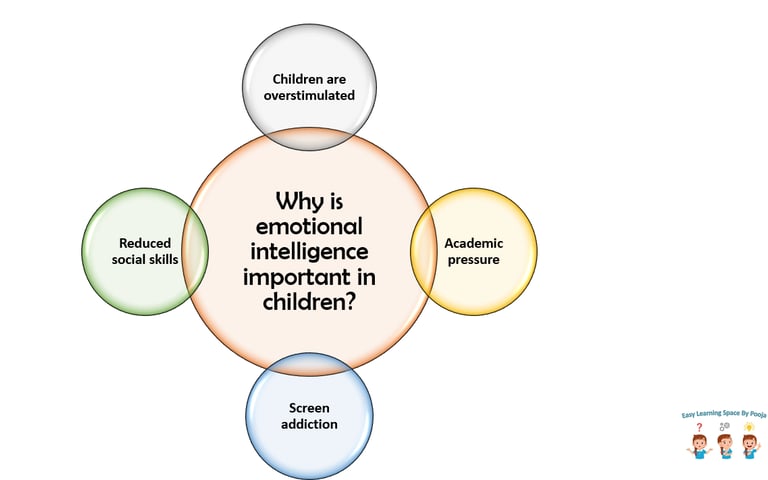
Why is there a need for children to be emotionally intelligent?
1. They are overstimulated
2. They have academic pressure
3. They undergo a lot of social pressure
4. Screen addiction
5. Reduced social skills
6. Higher anxiety levels
EQ acts like an inner compass, helping them feel safe, grounded, and confident in their world.
Activities for kids (aged between 2-3 years)
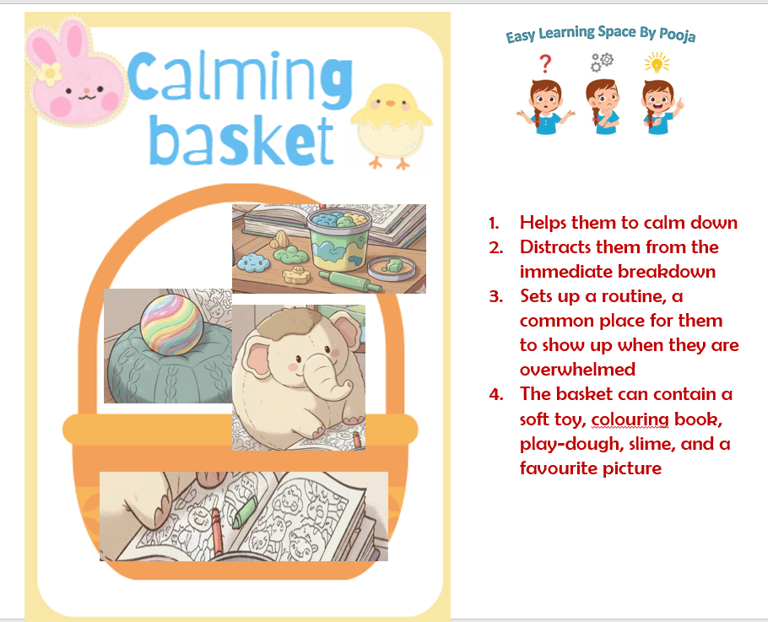
Self-soothing skills: Basket of emotions
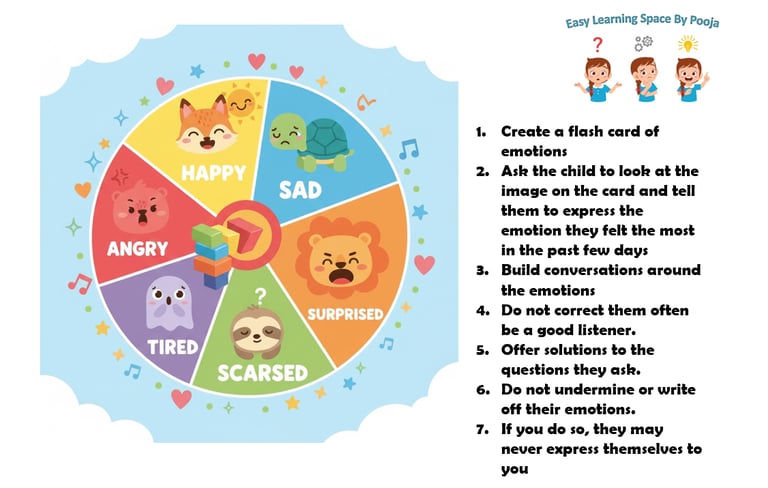
Children learn about feelings just like they learn about words, through repetition.
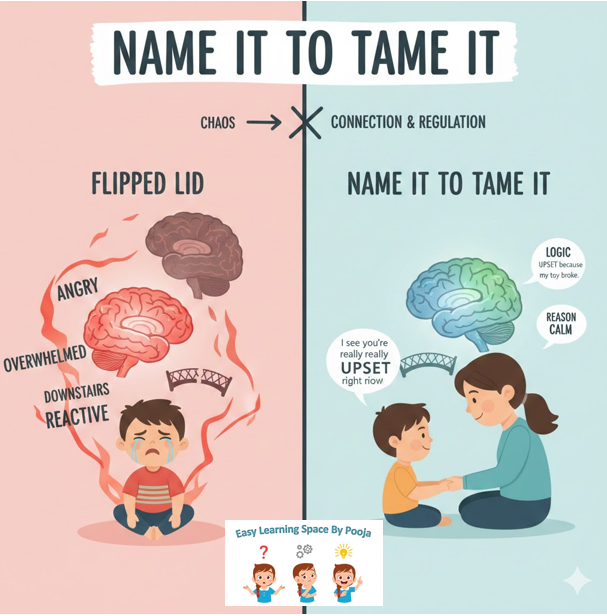
Name it to tame it (age 4+, Dr Dan Sigel method)
This is an amazing idea, backed by neuroscience. When a child is overwhelmed, their "downstairs" brain takes over, causing a "flipped lid"(When the right side and the left side of the brain are not working together it is called flip lid) and losing access to logic, making them highly reactive. To help them, you must first connect by getting on their level and offering physical comfort to soothe their emotions. Once they feel safe, name the emotion they are experiencing, which engages their "upstairs" brain and helps them transition back to a calm, rational state. By labelling the feeling, you bridge the gap between their emotions and logic, effectively "taming" the distress through understanding.
The "what would you" story game (age 5+)
Do a lot of stories reading with this age group of children. Pose them with indirect questions. Ask them what they would do in that particular situation and how differently they would react than the character did. For example, when I was narrating the story of "The woodcutter and his axes", I asked my son, what would you under such circumstances, which axe would you choose and why? He promptly replied, "I would have been very careful and never made the mistake of letting the axe fall in the river". Honestly I was stunned with his answer. I would have never thought about the situation in that way. Children will produce such gems when you aloow them to think freely without judging them. Kids rehearse emotional responses before they face them in real life.
The breathing exercises (all age groups)
This may seem very basic, but 5-7 minutes of deep breathing exercises can be a game-changer in any child's life. It has been scientifically proven to have an immediate effect. It calms down the nervous system, helps in the reduction of brain fog and gives the brain a much-needed clarity.
Hope you have enjoyed reading my blog. We need a much detailed post about the pre teens and the teenagers specifically, I am also doing a lot of trial-and-error methods some work and some do not. But there should be an intent to try. If you like my blog, do post a comment and write to me personally too. I will come up with some activities for pre teens and teenagers in my next blog! Till then, take care!
Love
Pooja!
Address
Pooja
Bangalore
Contacts
easylearningspacebypooja@gmail.com
Subscribe to our newsletter
This blog is for educational purpose only
All the information on this website – www.easylearningspace.com – is published in good faith and for general educational and informational purposes only. I aim to provide helpful teaching tips and resources, but I make no warranties about the completeness, reliability, and accuracy of this information.
Any action you take upon the information you find on this website is strictly at your own risk. I will not be liable for any losses