Big feelings, Smart choices. Learning and teaching emotional regulation in kids and us adults too
How to help children to understand their emotions, help them to regulate them. While we as adults also need to understand and manage our own emotions
PARENT, TEACHER, SCHOOL, HOME-SCHOOL, PARENTING, TEACHING AND LEARNING
Pooja
6/19/20264 min read
What are feelings? What do we mean by regulating feelings?
A few days ago, I was scrolling through a mall and suddenly heard loud sounds of a little girl screaming at her parents. The child was about three years old (I am assuming based on the vocabulary and language proficiency), and she was having a severe meltdown. This is very common among toddlers and tiny tots. What drew my attention was the way the child was expressing her emotions. The child clearly said that she did not like something and she was deeply hurt. The parents seemed completely taken aback and did not know what to do. There was complete silence from the parents' side and the child was inconsolable. This went on for a while, when an onlooker advised the parents to pick up the child and try to calm the child down, a classic case of free advice we give to parents about parenting in India. The parents picked up the child and vanished into thin air. This incident caught my attention so hard that I actually forgot the purpose of my visit to the nearest shop.
Just to be clear, I am not judging the parents, nor the child. My only focus was the emotions that were running in the foreground and the way that was being handled by both parties. Now, to understand this, we must understand the very basics of human instincts, "Emotions". Should kids and adults ignore their emotions? Definitely not! Should their emotions overpower their behaviour? Absolutely not. It is very important to have a clear picture of something called "Emotional regulation" Now, what is emotional regulation? sounds like a big/heavy word, but in reality it is not. Emotional regulation is nothing but the ability to recognise, understand, and manage emotions in healthy ways.
It doesn't mean suppressing feelings or pretending everything is fine when it isn't. A child need not suppress his/her anger, as an adult it is valid to express frustration at the end of an overwhelming day. The key difference lies in how we respond. Feeling angry is normal but hurting someone because you are angry is not. Feeling disappointed is natural giving up completely because of disappointment may not be helpful. Emotional regulation teaches us that while we cannot always control what we feel, we can learn to control what we do.
Why emotional regulation matters today more than ever?
Today's children are growing in a super fast-paced world with the burden of expectations, academic pressures and the most important, digital distractions. They are being raised in the lap of technology. Constant need to seek information within the tap of a button, doom scrolling and over exposure has reduced their attention span significantly and hence the wiring in the brain is totally different.
The science behind big feelings
One reason children struggle with emotional regulation is that their brains are still developing. The part of the brain responsible for decision-making, impulse control, and problem-solving develops gradually over many years. Young children often experience emotions intensely but lack the tools to manage them. Imagine feeling overwhelmed, frustrated, or scared without having the words to explain what you're experiencing. That's often what childhood feels like. This is why children need supportive adults who can help them navigate their emotions rather than punish them for having them.
As adults, we make many mistakes "Don't cry, it's just a toy". It might be just a toy for us, but for the child, it means much more. "So much drams for such a small thing?", " Relax, it's not a big deal", "You are fine, do not create a scene" Although these responses are usually well-intentioned, they unintentionally send a message.
Your feelings are not acceptable
You are invisible to me
feeling of being unheard and unseen
A simple rule of thumb in such situations is to accept and acknowledge their feelings. Acknowledging their emotions makes them feel heard and seen. As an adult, our job is that simple. Listen, understand and accept.
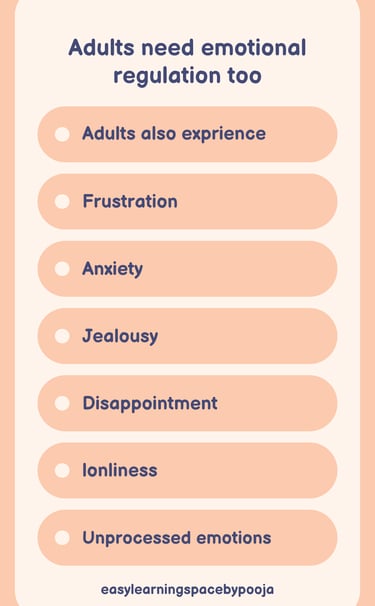
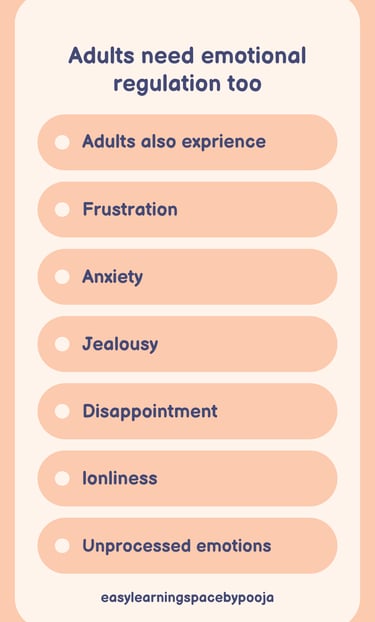
Adults need to regulate their emotions too.
Many adults grew up in environments where emotions were rarely discussed. Some were taught to "be strong" and hide their feelings. Others were never shown healthy ways to cope with anger, disappointment, or stress. As a result, many adults are learning emotional regulation later in life.
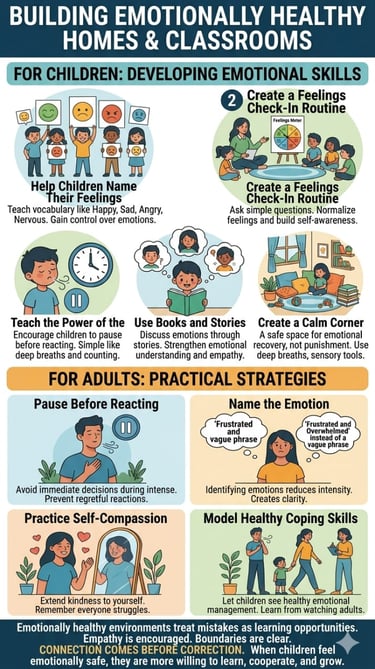
Emotional maturity doesn't mean never feeling these emotions. It means learning how to respond to them constructively. The journey of emotional regulation doesn't end in childhood. It continues throughout our lives. How can we deal with this? How do we make it easy for the kids and ourselves.
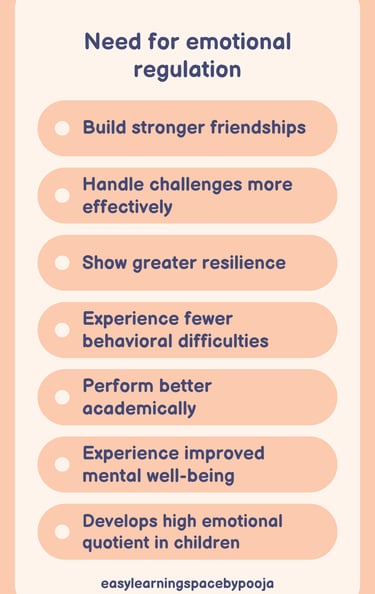
Emotional regulation is one of the greatest gifts we can give ourselves and the children in our lives. It teaches us that emotions are not enemies to fight or problems to fix. They are valuable signals that help us understand ourselves and the world around us. When children learn that all feelings are acceptable but not all behaviors are, they develop confidence, resilience, empathy, and self-control. And when adults continue working on their own emotional regulation, they become the role models children need most. The real skill is learning to make smart choices despite them.
Big feelings are inevitable. Smart choices are learnable. And it's never too early or too late to start.
Address
Pooja
Bangalore
Contacts
easylearningspacebypooja@gmail.com
Subscribe to our newsletter
This blog is for educational purpose only
All the information on this website – www.easylearningspace.com – is published in good faith and for general educational and informational purposes only. I aim to provide helpful teaching tips and resources, but I make no warranties about the completeness, reliability, and accuracy of this information.
Any action you take upon the information you find on this website is strictly at your own risk. I will not be liable for any losses